






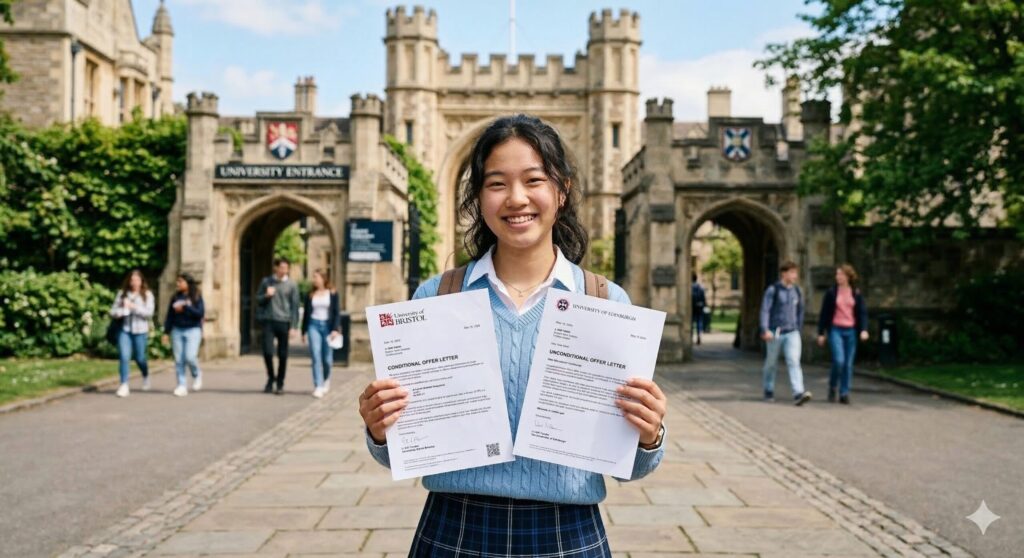
UK universities usually send out two types of offers: Conditional Offer Letter and Unconditional Offer Letter. Knowing the difference isn’t just about jargon. It can help you figure out your next steps, avoid surprises, and plan with confidence.
Conditional Offer Letter vs Unconditional Offer Letter
Here’s the detailed guide to know the difference between the Conditional Offer Letter and the Unconditional Offer Letter also known as CO(Conditional Offer Letter) and UCO(Unconditional Offer Letter)
Conditional Offer Letter(CO)
Conditional offer letter you have been accepted, but only you must first meet certain requirements. Think of it as a ‘’yes, but”.
Common Conditiond Include:
- Achieving specific grades in your current degree like 2:1 CGPA or 60% marks
- Meeting English requirements e.g ( an IELTS score of 6.5).
- Submitting missing documents: like reference letter or transcripts.
Example:
You have been offered a place on the MSc Data Science program, conditional on achieving a minimum 2:1 in your undergraduate degree and providing proof of English language proficiency.
Once you meet the condition and provide all the required documents you conditional letter automatically converted into unconditional offer letter.
Unconditional Offer Letter(UCO)
An unconditional offer letter means you already meet all the entry requirements and your place is secured. It’s essential that the university says yes, you’re in.
This usually applies if:
- You’ve already completed your previous studies and submitted all documents.
- You’ve meet the English language Requirements and academic requirements.
Example:
Congratulation you have been offered an unconditional offer letter on the MA International Relation Program starting September 2025.
Timelines For UK Universities Offer
Applying to a UK university isn’t just about sending in your application it’s a journey that unfolds step by step. Here’s what the typical timeline looks like:
September – January: Application season is in full swing. Most students apply through UCAS, and universities start reviewing applications.
February – May: The waiting ends this is when universities begin sending out offers (both conditional and unconditional).
May – July: Students make their choices, accept offers, and if they have conditions work on meeting them (like final exam results or English tests).
August: Big moment! A-level results are released, and universities confirm who has officially secured their place.
September: Time to pack your bags enrolment begins and courses officially start.
Things to consider when accepting an offer
Getting an offer is exciting, but deciding which one to accept takes a bit of strategy. Here are a few key things to keep in mind:
Confidence in Meeting Conditions: If you’ve been given a conditional offer, ask yourself honestly can I hit those grades or test scores? If your predicted results are strong, a conditional offer can still be a safe bet.
Scholarships & Financial Aid: Keep in mind, some scholarships are only awarded once your place is confirmed. An unconditional offer could make you eligible sooner.
Course & University Reputation: Don’t say yes to an unconditional offer just because it feels like a guaranteed spot. Make sure the course content, university reputation, and location align with your long-term goals.
Need help with your UK university Application
- Applying to a UK university can feel overwhelming from UCAS forms and personal statements to choosing the right university and sorting out visa requirements. That’s where BICAS CONSULTANCY UK LTD steps in.
- Our team offers personalize support at every stage of the journey, whether you’re:
- Writing a standout personal statement?
- Deciding which university best fits your goals
- Navigating UCAS deadlines and requirements
- Preparing for your student visa and life in the UK
- With the right guidance, the process doesn’t have to be stressful we make sure your path to studying in the UK is clear, smooth, and tailored to you.
What happened if I do not meet university requirements
If you don’t quite hit the grades your offer asked for, don’t panic — all hope isn’t lost. The university might still accept you, suggest a different course, or you can explore UCAS Clearing to find another great option.
Can I deffer unconditional offer to the next year?
Some universities will let you defer your place and start a year later, but the rules aren’t the same everywhere. Always check your university’s policy and make sure you follow their official process so your spot is secured.
A conditional offer letter from a UK university means that you have been offered admission, but you must meet certain requirements before your place is confirmed. These conditions usually include achieving specific academic grades, submitting final transcripts, meeting English language requirements such as IELTS, or providing required documents.
An unconditional offer letter means the university has confirmed your admission and you do not need to meet any further academic requirements. Once you accept the offer and complete administrative steps such as paying the deposit or confirming documents, you can proceed with your UK student visa application.
Common conditions in a UK conditional offer letter include:
Achieving required grades in your current qualification
Submitting final academic transcripts
Meeting English language requirements (IELTS, PTE, TOEFL)
Providing academic references
Completing document verification
Once these conditions are fulfilled, the university converts the offer into an unconditional offer.
To convert a conditional offer into an unconditional offer, students must submit proof that they have met all the requirements mentioned in the offer letter. This may include:
Final exam results
English language test scores
Required certificates or documents
After verification, the university issues an updated unconditional offer letter.
For a UK student visa (Student Route visa), you need a CAS (Confirmation of Acceptance for Studies) from the university. Universities usually issue a CAS after giving you an unconditional offer and after you accept the offer and meet financial requirements.
No, you cannot apply for a UK student visa with only a conditional offer letter. You must first fulfill all the conditions and receive an unconditional offer and CAS letter from the university before applying for your visa.
A conditional offer does not guarantee final admission until all conditions are met. If a student fails to meet the required grades or document requirements, the university may withdraw the offer or suggest alternative options.
After receiving an unconditional offer letter, you should:
– Accept the offer through UCAS or the university portal
– Pay the required tuition deposit (if applicable)
– Receive your CAS letter
– Prepare financial documents
– Apply for your UK student visa